
Global MBA applications rose roughly 7% in 2025, but the growth is concentrated at the top: more than half of the lowest-acceptance-rate programs grew, while many less selective programs shrank. For New York applicants targeting Columbia Business School and NYU Stern — both highly selective, both in the world's financial capital — that means a more competitive field, a higher effective GMAT Focus bar, and a real premium on getting your score, school list, and story aligned early.
If you are applying to MBA programs in New York — or targeting Columbia or NYU Stern from anywhere in the country — the 2025–2026 cycle rewards applicants who understand the data behind the headlines. Columbia's Class of 2027 drew 7,477 applications and enrolled 982 students, the largest M7 class, with an average GMAT Focus score of 690. NYU Stern received 4,933 applications, admitted 1,161, and posted an average GMAT 10th Edition score of 737. These are not abstract statistics; they are the medians your own application will be measured against, and they should shape every decision you make from your target score to your application round.
This guide walks through the global application surge and its local impact, the school-by-school numbers for Columbia and NYU Stern, what the GMAT Focus Edition means for your target score, the five forces driving this cycle, and a round-by-round timing strategy built specifically for New York applicants. Throughout, the goal is the same one we use in every MBA House application audit: turn data into a prioritized plan instead of a pile of facts.
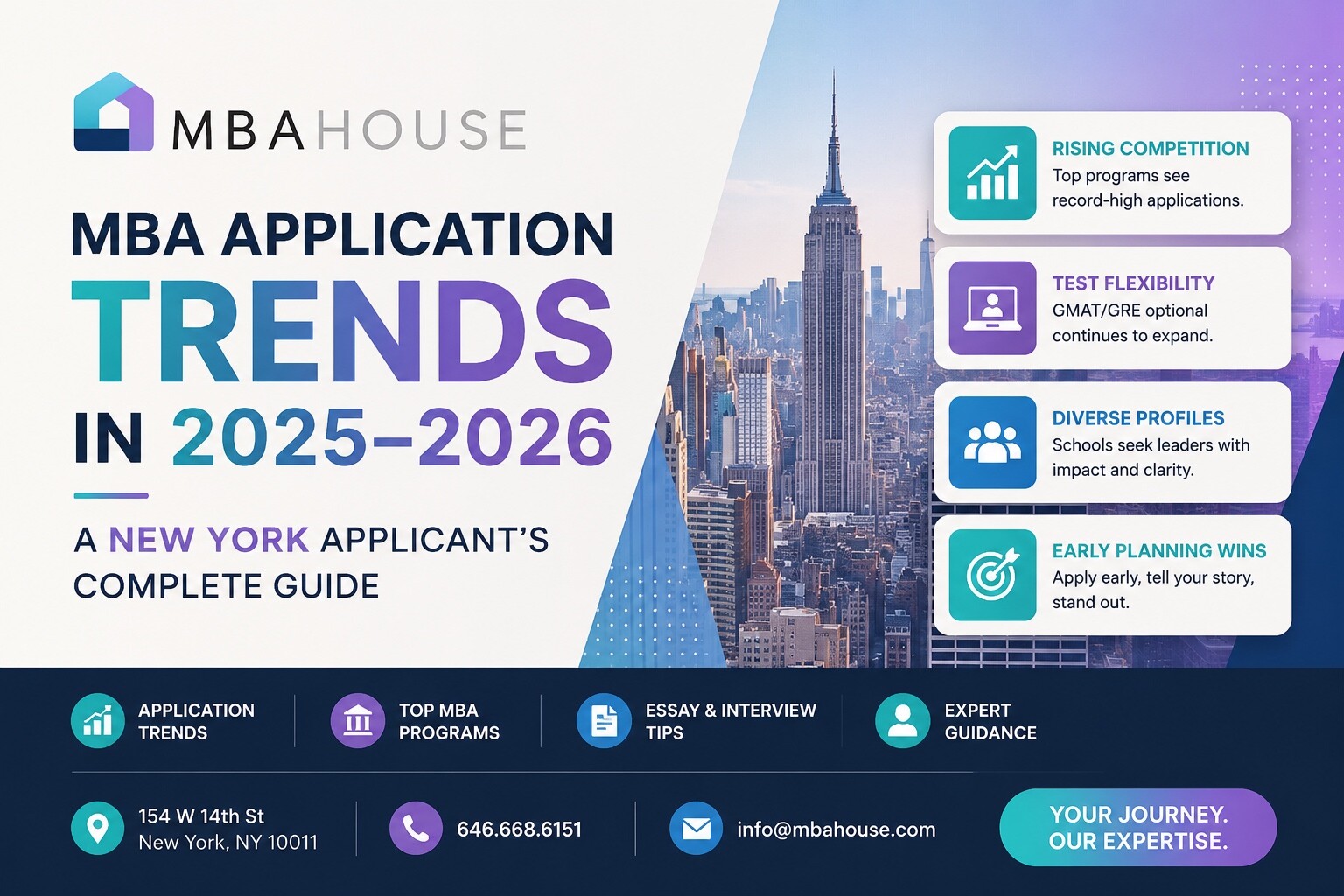
The 2025 MBA application surge: global numbers, local impact
The headline from the GMAC 2025 Application Trends Survey is a roughly 7% global increase in MBA applications. But the more important story is underneath it. Only about 49% of programs reported growth, down from 56% the year before, which means the average increase masks a widening split between winners and everyone else. Demand is not rising evenly — it is flowing toward the programs that were already hardest to get into.
That "flight to the top" is the defining feature of the cycle. Roughly 52% of the lowest-acceptance-rate programs reported application growth, compared with about 28% of the least selective programs. Applicants are concentrating their bets on brand-name, high-outcome schools, and the full-time, in-person MBA is the only format that grew at all — up about 4% year over year — while executive, flex, and online formats declined. The campus experience, the recruiting pipeline, and the network are pulling candidates back to the classic two-year model.
For New York applicants this is not a neutral trend. Columbia and NYU Stern sit squarely in the "winner" category: both are highly selective, both offer the full-time, in-person experience that is gaining share, and both feed directly into the finance and consulting firms that dominate hiring in the city. When demand concentrates at the top, it concentrates on exactly the programs most New York applicants are targeting. There was one more structural shift worth noting: in 2025, women surpassed men in MBA applications worldwide for the first time, a reminder that the applicant pool itself is changing alongside its volume.
| MBA format | 2024–2025 application trend | What it means for NYC applicants |
|---|---|---|
| Full-time, in-person (two-year) | Only format to grow (about +4% YoY) | Columbia and NYU Stern full-time programs are getting more competitive |
| Executive MBA | Declined | Less crowded, but fewer merit dollars; employer sponsorship more common |
| Flex / part-time | Declined | Still valid for working professionals who cannot pause income |
| Online MBA | Declined | Convenient, but the in-person network premium is widening |
Columbia Business School: the Class of 2027 by the numbers
Columbia Business School completed the M7 picture for the 2025 cycle with several school records. The program received 7,477 applications — close to flat year over year — but enrolled 982 students, the largest class among the M7. The reported acceptance rate sits around 25.7%, a touch more accessible on paper than the prior year, but the rise in class size and the strength of the pool mean the program is no less competitive for a seat that actually matters to you.
The academic profile tells the real story. Columbia's Class of 2027 posted an average GMAT Focus score of 690, an average GMAT 10th Edition score of 734, and an average GPA of 3.6. The incoming class skews heavily toward the industries that define New York: about 30% came from financial services, 23% from consulting, and 12% from technology. If your background is in any of those fields, you are competing directly against the strongest slice of that pool, which is precisely why a score at or above the 690 median carries weight.
Columbia's career outcomes reinforce why the school dominates New York applicant wish lists. In 2025 Columbia was ranked #1 globally for MBA finance careers, with 215 graduates — about 38.4% of the class — entering finance. Proximity to Wall Street is not a marketing line here; it is a placement pipeline. One nuance worth planning around: international enrollment dipped roughly 5%, driven by visa uncertainty and immigration policy, which can create marginal room for strong domestic applicants in both the admit pool and the scholarship pool. Columbia's unusual January-entry "J-Term" — a smaller cohort that skips the summer internship — remains a strong fit for sponsored candidates and career accelerators rather than career changers. You can read the full record-setting profile at Poets & Quants and a complementary breakdown at Clear Admit. For a deeper Columbia-specific playbook, see our guide on how to get into Columbia Business School.
NYU Stern: competitive admissions in the heart of Manhattan
NYU Stern is the other anchor of the New York MBA landscape, and its numbers are every bit as demanding. The most recent cycle drew 4,933 applications and produced 1,161 admits, an acceptance rate of roughly 24%. The class profile shows an average GMAT 10th Edition score of 737, an average GMAT Focus score of 682, an average GPA of 3.64, and about 5.1 years of average work experience. By prior industry, roughly 31% came from financial industries, 15% from consulting, and 8% from technology.
Stern's 2025 employment outcomes explain the demand. About 36.6% of graduates entered finance with a median salary of $175,000, and 32.8% entered consulting — with Big Three consulting hiring (McKinsey, BCG, Bain) rebounding sharply, up roughly 43% from 2024 to 2025. Technology placement also recovered, climbing from about 9.1% in 2024 to 14.2% in 2025, a visible sign of the AI-and-tech convergence reshaping where MBAs land. On the financial side, Stern awards merit scholarships to roughly 20–25% of admitted full-time students, with the majority being full or half tuition awards — a meaningful lever we cover in depth in our MBA scholarships guide for New York applicants.
For the official source data, see the NYU Stern class profile and the GMAC NYU Stern jobs and salary review. If Stern is a primary target, our dedicated guide on how to get into NYU Stern maps the essays, recommenders, and fit signals the program rewards.
One practical point about reading these profiles: an average is not a cutoff. Both Columbia and NYU Stern admit candidates below their published GMAT averages every year when the rest of the file is compelling — a distinctive career arc, demonstrated leadership, a quantitative transcript, or an underrepresented background. The averages tell you where the center of gravity sits, not where the door closes. What they should do is calibrate effort: if you are 30 points under a median, you now know your application has to over-deliver somewhere else, and you can decide deliberately whether to close that gap with a retake or to absorb it with a stronger narrative. That trade-off is the core of an honest application audit, and it is far more useful than the binary "am I above or below the average?" question most applicants fixate on.
What GMAT Focus score do Columbia and NYU Stern want? Treat the class median as your floor: about 690 for Columbia and 682 for NYU Stern on the GMAT Focus Edition. A score at or above the median strengthens both your admission odds and your scholarship leverage; a score 20–40 points below it usually signals that a targeted retake — not more essays — is your next best move.
The GMAT Focus Edition: what NYC applicants must know for 2025–2026
The testing landscape changed underneath this cycle. The classic GMAT was retired in February 2024, and the GMAT Focus Edition is now the only version available. It uses a new scoring scale of 205–805, and the single most important fact to internalize is the concordance: a 645 on Focus is equivalent to roughly 700 on the old GMAT, landing near the 87th percentile. In other words, "645 is the new 700." Anchoring to the old 700 benchmark without converting will quietly mislead your target-setting.
Across the M7, GMAT Focus averages cluster tightly: Columbia around 690, NYU Stern around 682, Stanford near 689, Wharton around 676, and Booth around 670. The exam itself has three sections — Quantitative Reasoning, Verbal Reasoning, and Data Insights — and no Analytical Writing component, though some programs layer on their own supplemental writing assessment. A competitive score typically takes 100–120 hours of focused preparation over two to four months, which is exactly why your test plan has to be sequenced against your application deadlines rather than treated as an open-ended project.
For the structural details of the exam, see our GMAT Focus explainer, and for how to build a prep plan that fits a working schedule, our guide to choosing a GMAT Focus tutor in NYC. If you are weighing the test against alternatives, the GMAT, GRE, Executive Assessment, and waiver decision guide walks through when a score is genuinely strategic. For independent benchmarks, Magoosh's average GMAT score tables and Menlo Coaching's GMAT Focus averages are useful references. When score and admissions strategy are built together — the approach we detail in why GMAT and MBA strategy should be one plan — the question stops being "how high can I score?" and becomes "what does this score need to prove for these schools?"
What's driving 2025–2026 application trends — and what it means for you
Five forces are shaping the current cycle, and each one carries a direct implication for how a New York applicant should plan.
- The full-time, in-person revival. Candidates want the campus experience, the network, and the recruiting pipeline back. For NYC, that means more pressure on Columbia and Stern full-time seats specifically.
- The selectivity premium. The hardest programs are pulling the most applicants. Aiming high now requires a genuinely competitive profile, not just a strong one.
- The international pullback. Visa and immigration uncertainty trimmed international volume at U.S. programs — about 5% at Columbia — which can modestly help strong domestic applicants.
- The AI and skills focus. Nearly half of prospective students now call AI coursework essential, up from 29% in 2022, and that is reshaping how essays and career goals should read. We dig into this in our guide to how AI is reshaping the MBA for New York finance and consulting careers.
- ROI consciousness. Rankings dropped from about 37% to 29% as a top research factor, while career outcomes and ROI climbed. Candidates now expect roughly 30% of costs covered by grants and scholarships, up from 25% in 2019.
It is worth sitting with how much each of these forces compounds the others. The full-time revival concentrates demand on a small set of brands; the selectivity premium then sorts that demand toward the very top of those brands; the ROI lens pushes candidates to chase the programs with the best published outcomes, which are largely the same selective programs; and the AI-skills shift raises the bar on what a competitive career story has to demonstrate. For a New York applicant, all four arrows point at Columbia and Stern. That is not a reason for discouragement — it is a reason for precision. When a field is this concentrated, generic strengths get lost and specific, well-evidenced ones stand out. A clearly articulated reason why this school, in this city, for this career, backed by a score at or above the median and a story that reads forward rather than backward, is what separates an admit from a near-miss in a crowded pool.
The throughline is that applicants are behaving more like investors than shoppers. They are comparing programs on outcomes and net cost, applying selectively to the strongest brands, and expecting schools to share the financial load. For the underlying data, see the GMAC Application Trends Survey, GMAC's own 2026 application-trends outlook, the prospective-student analysis at Stacy Blackman Consulting, and the forward-looking view at My MBA Path.
Timing and strategy for NYC applicants: a round-by-round calendar
In a competitive cycle, when you apply matters almost as much as how strong your application is. The choice between Round 1 and Round 2 is not about prestige; it is about readiness, scholarship timing, and your own risk profile.
Round 1 is generally the strongest window for scholarship consideration, because more merit dollars are unallocated early, and it is essential for international candidates who need visa lead time. It rewards applicants whose GMAT Focus score is already at target and whose essays are genuinely done. Round 2 is a legitimate choice for well-prepared domestic applicants who need a few more weeks to push a score across a median or to sharpen a career narrative — submitting a polished Round 2 file beats rushing an unfinished Round 1 one. Round 3 is the riskiest at top programs, where most seats and most aid are already committed.
Columbia adds its own wrinkle with the J-Term (January entry), a smaller cohort best suited to sponsored candidates and accelerators who do not need a summer internship, plus a regular August-entry track with rolling-style review that rewards applying early. NYU Stern runs conventional rounds with firm deadlines; applying in Round 1 there also strengthens merit-scholarship positioning. If you find yourself waitlisted in this environment, treat it as an open application, not a rejection: a focused update letter, a new recommendation, or a recent score improvement can change the outcome.
| Your situation | Best round | Why |
|---|---|---|
| Score at target, essays done, want maximum aid | Round 1 | More scholarship dollars unallocated; signals commitment |
| International candidate needing visa lead time | Round 1 | Earlier decision protects the visa timeline |
| Domestic applicant needing 4–8 more weeks on score or essays | Round 2 | A finished file beats a rushed one; aid still available |
| Sponsored / career accelerator, no internship needed | Columbia J-Term | Smaller cohort, accelerated track |
| Late decision-maker, profile not yet competitive | Wait for next cycle | Round 3 odds and aid are thin at top NYC programs |
We map your GMAT Focus target, school list, deadlines, and scholarship goals onto one timeline anchored to real work weeks — not an idealized study schedule. The output is a prioritized next-step plan that tells you what to do this month and what to leave alone, whether you meet us in person at 154 W 14th Street or remotely from anywhere in the country.
What this means for your application strategy
Put the pieces together and a clear strategy emerges for the 2025–2026 cycle. The application surge is real but concentrated, so the schools most New York applicants want are also the ones absorbing the most new demand. That raises the effective bar on the one quantitative signal admissions committees can compare directly across applicants: your GMAT Focus score. Setting that target backward from the Columbia and Stern medians — and then deciding honestly whether a retake or a sharper essay is your binding constraint — is the highest-leverage move you can make.
The international pullback and the schools' use of merit aid as a recruiting tool also mean that a strong domestic New York applicant has genuine negotiating room, especially in Round 1. And the shift toward ROI and AI-fluent career narratives means your essays should read like an investor's thesis about your own future, not a recap of your resume. New York's structural advantage — proximity to the finance and consulting firms that hire from Columbia and Stern — is itself a story worth telling, because it signals that you understand exactly where this degree leads. If you are still deciding whether to bring in outside help to diagnose all of this, our piece on whether you need an MBA admissions consultant walks through who benefits most.
The takeaway for New York applicants
The 2025–2026 cycle is competitive, but it is also legible. Applications are up, the top programs are pulling the field, and Columbia and NYU Stern sit right in the path of that demand. For a New York applicant, the response is not to panic about volume — it is to plan with precision: target the right GMAT Focus score for your specific list, choose your round based on genuine readiness rather than the calendar, build essays around AI-aware, outcome-driven career goals, and use the domestic and Round 1 advantages that this particular cycle hands you. Start with an honest audit, set the score target from your real school list, and build everything on one deadline-anchored timeline.
Book a free 30-minute MBA Strategy Call with an MBA House admissions consultant. We are New York's in-person, one-stop GMAT and MBA admissions shop — and we help map your score target, school list, timeline, and scholarship goals into a single plan. Bring your target schools, score history, and transcript context.
Book a free strategy call Compare GMAT + admissions packages