
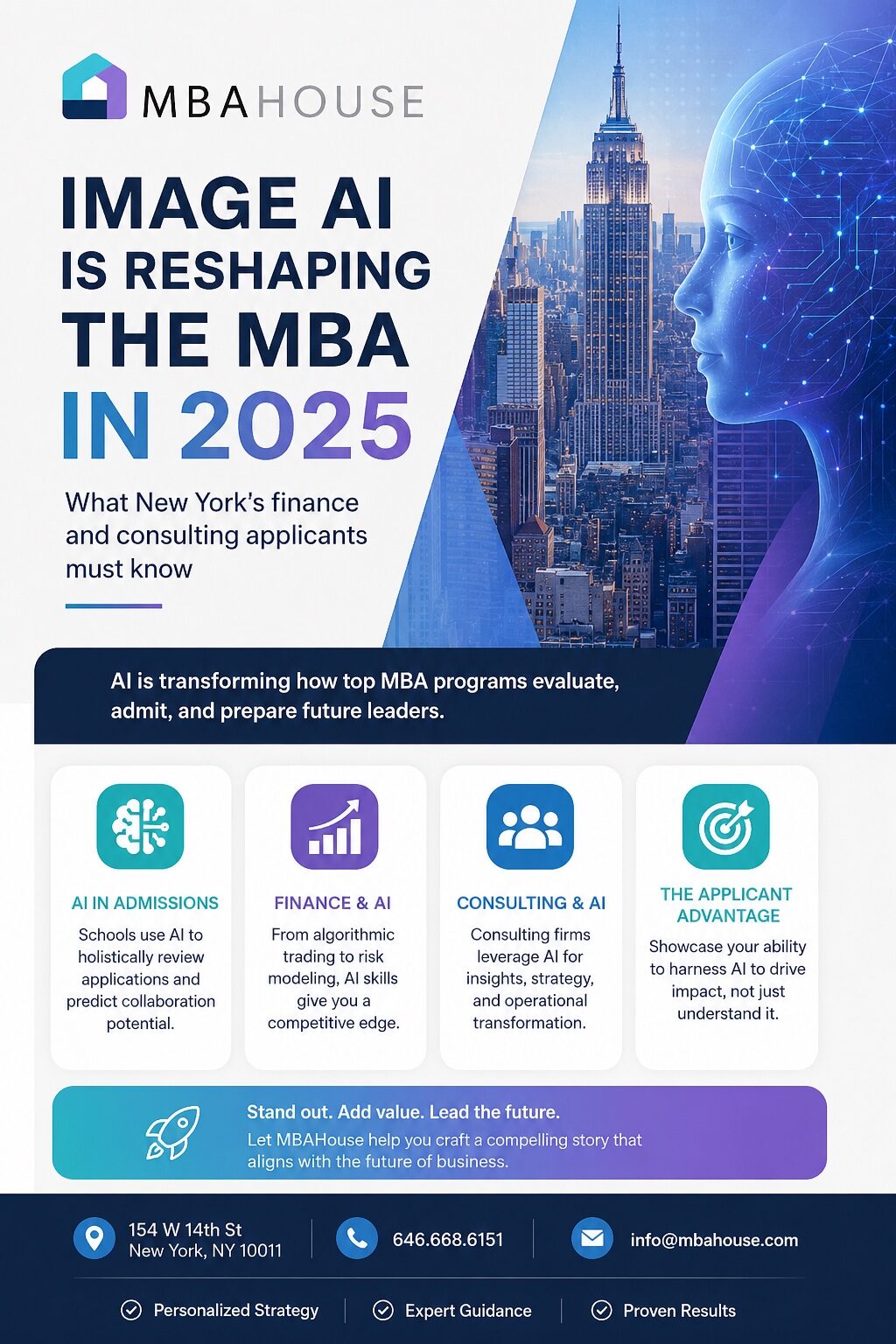
AI is not disrupting the MBA — it is making the right MBA more valuable, especially in New York. Nearly half of prospective students now call AI coursework essential, up from 29% in 2022. Columbia and NYU Stern have built AI offerings into their programs, and their 2025 graduates poured into finance and consulting roles that increasingly demand AI fluency. For a New York applicant, the winning move is to pair a strong, quantitative application with a specific, AI-aware career story.
Nearly half of all prospective MBA students now say AI coursework is "essential" to their ideal program — a striking jump from just 29% in 2022. For applicants targeting MBA programs in New York City, that statistic lands with extra force, because New York is where two powerful trends collide. It is the world's financial capital, home to Goldman Sachs, JPMorgan, Morgan Stanley, and BlackRock, and it is also one of the places where AI is most aggressively rewriting how financial services actually operate. Firms are no longer asking whether AI matters; they are rewriting job descriptions around AI fluency and hiring MBAs to lead that change.
This guide covers what the 2025 data says about AI in business education, what Columbia Business School and NYU Stern are doing with AI in their curricula, what finance and consulting career outcomes look like for New York MBA graduates this year, which programs are best positioned for AI-era careers, and — most practically — how to position your own MBA application for this moment. It pairs naturally with our look at the broader 2025–2026 MBA application trends for New York applicants, which sets the competitive backdrop for everything here.
The AI imperative in business education: 2025 data
The demand signal is unambiguous. The GMAC 2025 Prospective Students Survey found that 48% of candidates now consider AI coursework essential to their ideal MBA experience, up from 29% in 2022. On the supply side, the GMAC Application Trends Survey identified new, AI-centered business school offerings as a defining feature of the 2025 cycle — schools are racing to build what students are demanding. And the GMAC Corporate Recruiters Survey ranks the use of AI tools as one of the fastest-growing skills in terms of employer-rated importance, even as 99% of employers continue to trust graduate management education to prepare graduates for success.
The labor-market evidence is just as clear. Analyses drawing on PwC and AWS data point to a roughly 42% salary premium for AI-fluent professionals, and about 78% of CFOs say their teams need stronger AI skills. LinkedIn data shows AI-related job postings rising sharply year over year, and the share of professionals listing AI skills on their profiles has multiplied many times over since 2016. Put together, the picture is of a labor market that pays a meaningful premium for people who can combine domain expertise with AI capability — and a business-education market scrambling to produce them.
It helps to be precise about what "AI fluency" means in a finance or consulting context, because the phrase gets used loosely. Employers are not, for the most part, looking for MBAs to train models from scratch — that is a job for specialist engineers. What they want is a manager who understands what these tools can and cannot do, who can scope an AI project realistically, who can judge when a model's output is trustworthy enough to act on, and who can translate between a technical team and a business line that needs a decision. That is fundamentally a management skill layered on top of quantitative literacy, which is exactly what a strong MBA is built to develop. The 42% premium, read correctly, is a premium on judgment about AI, not just exposure to it — and judgment is precisely what an MBA, with its case method and cross-functional rigor, is designed to build. For the underlying surveys, see the GMAC Application Trends Survey, the prospective-student analysis at Stacy Blackman Consulting, and the practitioner view from Wall Street Prep on AI for finance professionals.
What Columbia Business School and NYU Stern are doing about AI
The two anchor programs of New York's MBA scene have responded directly. Columbia Business School — ranked #1 globally for MBA finance in 2025 — co-developed an AI for Business and Finance certificate in partnership with Wall Street Prep through its Executive Education arm. The program teaches Python, machine learning, predictive analytics, and generative AI applied specifically to finance workflows, which is exactly the hybrid of quantitative method and domain application that employers are paying a premium for. You can review the program at the Columbia AI for Business and Finance certificate page.
NYU Stern, for its part, offers an AI strategy course aimed at professionals with five or more years of experience, focused on AI strategy, management, and the organizational implications of adopting these tools — delivered in person at Stern's Manhattan campus. GMAC lists both NYU Stern and Columbia among the top schools offering AI for business courses, a useful signal that these are not one-off electives but part of a deliberate curricular shift. The broader pattern, documented across business education, is AI moving in from two directions at once: top-down through formal curriculum design, and bottom-up through individual faculty experimentation. Non-degree and certificate programs are expanding fastest, often through employer partnerships, while the core MBA increasingly embeds data insights, fintech, and digital-transformation content as standard rather than specialist material.
For the wider context, GMAC's overview of AI for business courses lists the leading programs, and Poets & Quants offers a detailed report on how AI is reshaping the MBA. The practical takeaway for applicants: when you write about your target school, you should be able to name the specific AI offering you intend to use and why it fits your goals.
Where do New York MBA grads actually land in 2025? Finance and consulting still dominate. About 38.4% of Columbia's class and 36.6% of NYU Stern's class entered finance, and roughly a third of Stern's class entered consulting — with Big Three hiring rebounding and technology placement climbing. The roles increasingly blend traditional finance and consulting work with AI implementation and strategy.
Finance career outcomes for NYC MBA grads in 2025
The placement data shows why New York remains the center of gravity for finance-focused MBAs. Columbia Business School was ranked #1 globally for MBA finance careers in 2025, with 215 graduates — about 38.4% of the class — entering finance, an outcome powered in no small part by sitting in the financial capital of the world. NYU Stern sent 36.6% of its 2025 graduates into finance at a median salary of $175,000, and 32.8% into consulting, with Big Three consulting hiring (McKinsey, BCG, and Bain) rebounding strongly from the prior year. Stern's technology placement also jumped, from about 9.1% in 2024 to 14.2% in 2025 — the AI-and-tech convergence showing up directly in the numbers.
For benchmarking, Stanford's finance graduates posted a median salary near $200,000, and Wharton placed about 36.7% of its class — roughly 205 students — into finance. The top employers of New York-school MBA graduates remain the firms you would expect: McKinsey, Goldman Sachs, JPMorgan, and Morgan Stanley. What is changing is the nature of the roles. These firms are increasingly hiring MBAs not only for traditional investment banking, private equity, and strategy work, but for positions in AI implementation, model governance, and strategic AI application. The MBA who can sit between a quantitative AI team and a business line — translating model capabilities into commercial decisions — is exactly the profile in demand.
The technology rebound at Stern deserves a second look, because it is where the AI-finance convergence is most visible. A jump from roughly 9.1% to 14.2% of the class entering technology in a single year is not noise — it reflects MBAs moving into product, strategy, and operations roles at firms building AI into financial and enterprise software. For a New York applicant, this widens the realistic opportunity set: the same degree that opens banking and consulting doors now also opens roles at fintechs, AI-focused startups, and the technology arms of incumbent financial firms. The boundary between "finance career" and "tech career" is blurring, and the MBAs who benefit most are the ones who position themselves deliberately at that seam rather than picking one lane and ignoring the other.
That shift has a direct implication for your application essays. It is no longer enough to say you want to "work in finance" or "go into consulting." The strongest narratives articulate how you will combine finance or consulting expertise with AI fluency to do something specific. For the source data on outcomes, see GMAC's best MBAs for finance resource and the NYU Stern jobs and salary review. The wider job-market picture is well summarized by AACSB's 2025 business school job-market analysis.
| Program | 2025 finance placement | Notable 2025 signal |
|---|---|---|
| Columbia Business School | 38.4% into finance (215 grads) | #1 globally for MBA finance careers |
| NYU Stern | 36.6% into finance ($175K median) | 32.8% into consulting; Big Three hiring rebounded |
| Wharton | 36.7% into finance (~205 grads) | Benchmark M7 finance pipeline |
| Stanford GSB | Smaller share, ~$200K median | High-compensation finance benchmark |
Key New York MBA programs for AI-era finance and consulting careers
If your goal is a finance or consulting career shaped by AI, a handful of New York programs deserve close attention, each with a distinct fit.
- Columbia Business School. M7, dual August/January entry, average GMAT Focus around 690, #1 for finance, with deep Wall Street connections and an incoming class that is roughly 30% financial services and 23% consulting. Its AI for Business and Finance certificate is a clear signal of curricular intent.
- NYU Stern. Top-15, Manhattan-based, average GMAT Focus around 682, with strong finance and consulting placement and an in-person AI strategy offering. Stern's Andre Koo Technology MBA — a one-year option — is especially relevant for candidates leaning into the tech-finance convergence.
- Fordham Gabelli School of Business. A strong, finance-focused New York option that gets less national coverage but is genuinely relevant for local applicants, particularly part-time candidates who want to stay employed in the city.
- Executive MBA options. NYU Stern's EMBA (alternating Friday/Saturday format) and Columbia's Executive MBA serve experienced New York professionals who want the brand and network without leaving the workforce.
When you compare these programs through an AI lens, look past the marketing and ask three concrete questions. First, does the school offer hands-on AI coursework you can actually take as an MBA student, or only executive-education add-ons? Second, where do its graduates land — does the placement data show movement into the AI-adjacent finance, consulting, and technology roles you are targeting? Third, what is the program's proximity to the firms doing this work, since access to recruiters, guest practitioners, and live projects compounds the value of the curriculum? On all three, Columbia and NYU Stern score well precisely because they sit inside the New York ecosystem where AI-in-finance is being built. That geographic advantage is hard to replicate from a campus far from the action, and it is a legitimate factor to weigh in your school list rather than an afterthought.
Part-time and online formats remain valid for working professionals even though their application volumes declined in 2025 — the trade-off is a thinner in-person network against the ability to keep earning. Across all of these, the GMAT Focus Edition is scored on the 205–805 scale, and a target in the 645–690 range is the right benchmark for the selective programs above; our GMAT Focus explainer covers exactly how the Quant, Verbal, and Data Insights sections work and why quantitative strength is doubly valuable in an AI economy.
How to position your MBA application for the AI era
Admissions committees in 2025–2026 are reading for a particular kind of awareness: candidates who understand that AI is changing their field and who can show, concretely, how they intend to operate in that changed landscape. The applicants who stand out are not the ones who declare an interest in AI — they are the ones who demonstrate a plan.
- Make the essay specific. Do not say you "want to learn AI." Show how you will use it — automating diligence in private equity, deploying generative models in client-facing consulting, building AI-driven risk tooling in banking. Specificity reads as credibility.
- Frame career goals around real roles. Name the role: fintech product manager, AI strategy consultant, digital-transformation lead, model-governance analyst. Vague ambition is forgettable; a concrete target is memorable.
- Treat the GMAT as a foundation, not a hurdle. In an AI-driven economy, demonstrated quantitative reasoning matters more, not less. A strong Quant and Data Insights performance signals exactly the analytical readiness these careers require.
- Use your New York proximity as a story. Being close to the firms shaping AI in finance is itself evidence that you understand where this degree leads — lean on it.
- Network before you apply. Alumni events, firm visits, and conversations with current students in AI-and-finance roles give your essays texture no template can provide.
This is also where working with a specialist New York admissions consultant earns its value: the committee's expectations around AI-era narratives are new and still shifting, and a consultant who knows what Columbia and NYU Stern actually reward can keep your story credible rather than buzzword-heavy. We develop the broader case for building score and admissions strategy together in why your GMAT and MBA strategy should be one plan, and our application-strategy guide for NYC goes deeper on career positioning and essay architecture.
Practical steps for New York MBA applicants in 2025
Here is an actionable checklist for translating all of the above into a plan:
- Set your GMAT Focus target. Aim for 665–690 to be competitive at Columbia and NYU Stern, and build the prep plan backward from your application deadline.
- Identify 2–3 AI course offerings at each target school and be ready to reference them by name in your essays.
- Connect with current students and alumni working in AI-and-finance or AI-and-consulting roles to ground your goals in reality.
- Draft a career-goals statement that bridges your current role with AI transformation in your specific industry.
- Apply in Round 1 for the strongest scholarship consideration, as detailed in our MBA scholarships guide.
- Work with a consultant who knows the AI-era expectations of Columbia and NYU Stern, so your narrative is specific and credible rather than generic.
We help New York applicants build an AI-era application narrative that holds up — pairing GMAT Focus prep that strengthens the quantitative signal with admissions strategy that turns "I want to work with AI" into a specific, credible career thesis. In person at 154 W 14th Street, or remotely nationwide.
Why this is an opportunity, not a threat
It is tempting to read the AI headlines as a warning that the MBA is losing relevance. The data points the other way. Employers still overwhelmingly trust graduate management education, they are paying a premium for AI fluency, and they are creating new MBA-level roles at the intersection of business judgment and AI capability. What is changing is the kind of MBA that wins — one that combines quantitative rigor with a concrete, AI-aware plan for a specific industry. New York, where finance and AI transformation overlap most densely, is arguably the best place in the world to pursue exactly that combination.
The window favors candidates who can articulate this clearly in the 2025–2026 cycle, before "AI fluency" becomes a baseline expectation rather than a differentiator. The applicants who can show — not just claim — that they understand how their field is changing, and who back that story with a competitive GMAT Focus score and a coherent school list, have a genuine advantage right now. For the financial side of the decision, our guide to financing an MBA and the Cornell SC Johnson analysis of MBA ROI are useful complements.
The takeaway for New York applicants
AI is reshaping the MBA, but in New York it is reshaping it toward opportunity. Columbia and NYU Stern have built AI into their programs; their graduates are landing in finance and consulting roles that increasingly demand AI fluency; and the labor market is paying a premium for the combination. The applicants who win in this environment are the ones who treat AI not as a buzzword to sprinkle into an essay but as the organizing logic of a specific career plan — backed by a strong, quantitative application and a school list calibrated to their goals. Start with an honest read of where your story is specific and where it is generic, set your GMAT Focus target from your real list, and build everything on one deadline-anchored timeline.
Schedule a free MBA Strategy Call to map your AI-era application narrative. We are New York's in-person, one-stop GMAT and MBA admissions shop — and we have helped 2,000+ applicants into top programs, including Columbia and NYU Stern.