
Scholarships in 2025–2026 are won, not waited for. Candidates now expect roughly 30% of MBA costs to be covered by aid, up from 25% in 2019. The biggest single lever is your GMAT Focus score: a number at or above a school's median makes you the kind of applicant programs use merit dollars to attract. At NYU Stern, 20–25% of admits receive merit awards — most full or half tuition — and applicants are considered automatically. The playbook is clear: score high, apply early, tell a sharp story, and negotiate professionally.
MBA House has helped its clients secure more than $10 million in scholarship awards, including a $130,000 scholarship to MIT for one recent client. We share that number not to boast but to make a point: scholarship money at top programs is highly responsive to strategy. The applicants who win the most aid are rarely the ones with the most luck — they are the ones who understood the levers and pulled them deliberately. For New York applicants targeting Columbia Business School and NYU Stern, two of the most scholarship-relevant programs in the country, that strategy is the difference between full-pay and a six-figure discount.
This guide covers how the 2025–2026 scholarship landscape has shifted, the specific scholarship programs at Columbia and NYU Stern, why the GMAT is the master scholarship lever, a step-by-step negotiation playbook, an honest ROI framework, and the options available to working professionals considering an Executive or part-time MBA. It builds on the competitive backdrop we lay out in our 2025–2026 MBA application trends guide and our foundational article on how to get MBA scholarships.
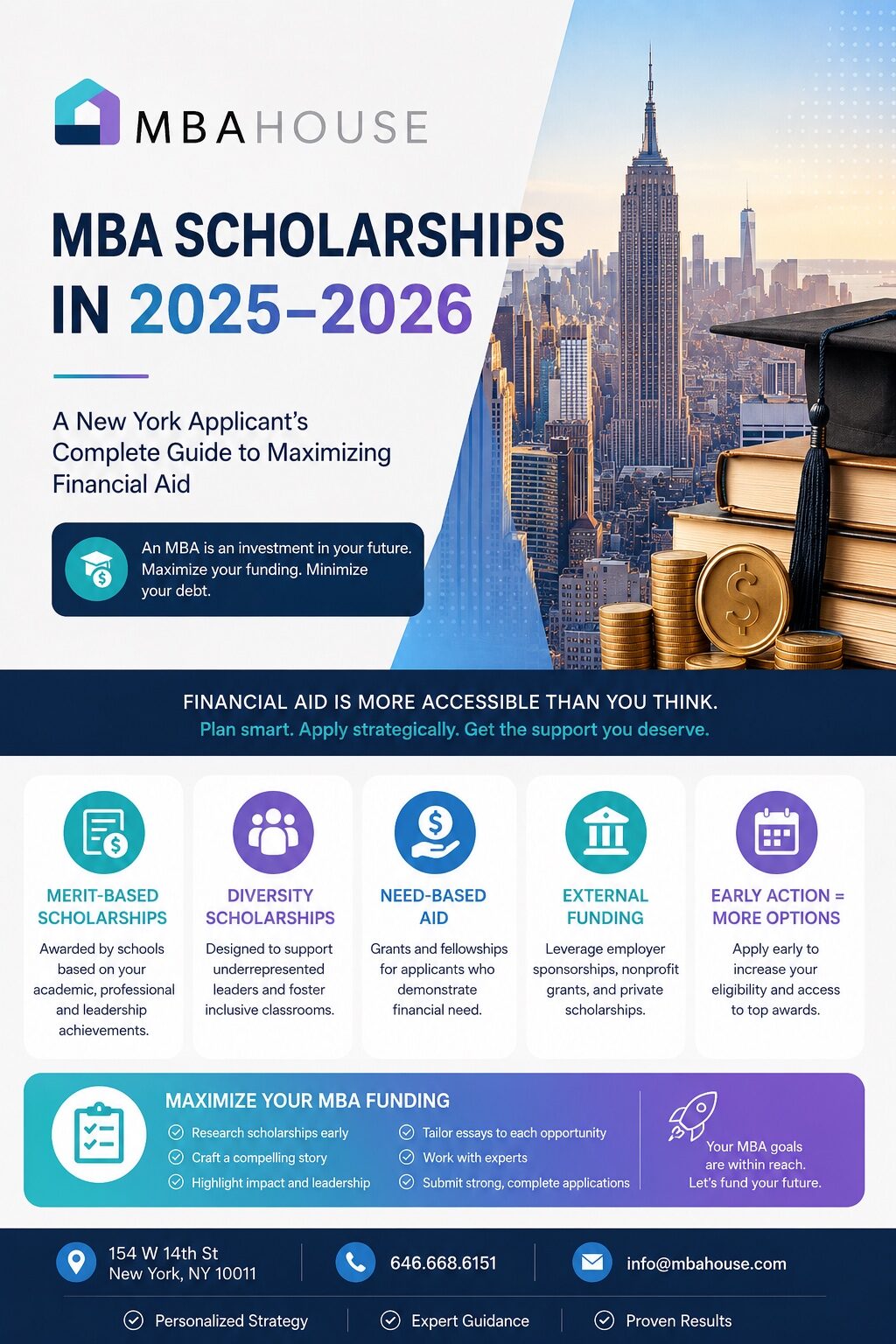
The 2025–2026 MBA scholarship landscape: what's changed
The expectations around aid have shifted measurably. According to GMAC's 2025 Prospective Students Survey, candidates now expect roughly 30% of their MBA costs to be covered by grants and scholarships, up from about 25% in 2019 — and reliance on parental support is declining. Cost remains the number-one barrier to enrollment, with nearly half of global respondents naming it among their top three concerns. Millennial, first-generation, and underrepresented U.S. candidates show especially high reliance on financial aid, which means scholarships are not a nice-to-have at the margin; for many strong applicants they are the deciding factor in where they enroll.
The "flight to selectivity" we have seen across the 2025 cycle creates a particular scholarship dynamic. Top schools are flush with strong applicants, which might suggest they have no need to offer aid — but the opposite is true at the top of the pool. Programs use scholarships as recruitment tools to win yield battles for their most desirable admits, the candidates who lift reported averages and who are also being courted by peer schools. That is precisely why a strong, well-positioned applicant has leverage even at a highly selective program. The 2025–2026 context adds one more wrinkle for New York applicants: international applications to U.S. programs declined — about 5% at Columbia — which can modestly improve the position of strong domestic candidates in both admit and scholarship pools. For the underlying survey data, see the prospective-student analysis at Stacy Blackman Consulting.
It is worth distinguishing the two main forms of aid. Merit-based aid rewards the strength of your application — scores, profile, leadership, and fit — and is the lever most responsive to strategy. Need-based aid responds to financial circumstances and is awarded through a separate process. This guide focuses primarily on merit aid, because that is where your application choices have the most direct impact on the dollars you receive.
There is a timing dimension to all of this that many applicants miss. Scholarship budgets are not infinite, and they are not released evenly across the application cycle. The largest, most flexible pool of merit dollars is typically available in Round 1, before a school has committed funds to its earliest admits. By Round 2 the budget is partly spoken for, and by Round 3 there is often little merit money left even for strong candidates. For a New York applicant who is genuinely ready, this is a direct argument for applying early: the same application that earns a partial award in Round 2 might earn a larger one in Round 1 simply because the money was there. The corollary is that rushing an unfinished Round 1 application to chase aid is self-defeating — a weak early file wins nothing. The right move is to be ready early, which means starting the GMAT and the essays far enough ahead that Round 1 is a real option rather than a gamble.
Columbia Business School: scholarship programs and strategy
Columbia's reported acceptance rate for the Class of 2027 is around 25.7% — slightly more accessible on paper, but no less competitive for merit funding. The class posted an average GMAT 10th Edition score of 734 and an average GMAT Focus score of 690, which is the practical floor to keep in mind: at a program where the median is that high, a score below it weakens both admission and scholarship positioning, while a score above it strengthens both.
Merit scholarships at Columbia Business School are generally offered at the point of admission, and for most awards no separate application is required — your standard application is your scholarship application. The school offers a range of fellowship programs and named scholarships, and the January-entry J-Term, with its smaller cohort, can offer a different competitive dynamic for the right candidate. The differentiators that make a Columbia applicant competitive for merit funding are consistent: quantitative strength signaled by a strong GMAT or GRE score, clarity of career direction, a leadership narrative with evidence behind it, and — where applicable — an underrepresented profile. With about 30% of the incoming class coming from financial services, New York finance professionals are a natural fit, but that also means the competition within that segment is intense, which raises the value of a score and story that stand out.
The single most important step to maximize your scholarship chances at Columbia is a high GMAT or GRE score, a point made directly by scholarship-strategy resources such as BSchools.org. For the full Class of 2027 data, see the Poets & Quants profile and the Clear Admit breakdown, and our dedicated guide on how to get into Columbia Business School.
NYU Stern: named scholarships, merit awards, and NYC-specific programs
NYU Stern is one of the most scholarship-generous top-15 programs in the country. The school awards merit scholarships to roughly 20–25% of admitted full-time two-year MBA students, and the majority of those awards are full or half tuition — potentially $80,000 to $160,000 in value. Critically, all of Stern's named scholarships require no separate application; admitted applicants are automatically considered based on their standard file.
Stern's named scholarships include several with distinct profiles:
- William R. Berkley Scholarship — full tuition, tied to the NYU and Stern undergraduate pipeline.
- Advancing Women in Business Scholarship — full tuition plus mandatory fees for two years.
- Elizabeth Elting Advancing Women's Leadership Fellowship — $50,000 per year.
- Directors Scholarship — $50,000 in the first year.
- Community Scholarship — $25,000 in the first year.
- Howard Gilman Foundation Scholarship — for candidates with performing-arts backgrounds.
Beyond the first-year awards, Stern considers all students automatically for second-year donor awards, so scholarship potential does not end at admission. The class profile — an average GMAT 10th Edition score of 737 and an average GMAT Focus score of 682 — sets the benchmark for scholarship-targeting: aim at or above those numbers. Stern's 24% acceptance rate means the scholarship pool is competitive, but the breadth of named awards and the automatic-consideration model reward applicants whose profiles align with the school's priorities, including its commitments to diversity. See the official NYU Stern scholarships page and the Stern class profile, plus our guide on how to get into NYU Stern.
What is the fastest way to increase my MBA scholarship? Raise your GMAT Focus score above your target schools' medians. Merit aid flows to applicants who lift a program's reported averages, so every 20-point gain can move you from "competitive admit" to "merit scholarship candidate" — a swing often measured in tens of thousands of dollars.
The GMAT score as the master scholarship lever
If there is one idea to take from this guide, it is that your test score is the most controllable scholarship variable you have. Here is why. A GMAT Focus score of 645 corresponds to roughly 700 on the old GMAT and sits near the 87th percentile. For scholarship consideration at Columbia and NYU Stern, the practical target is 665–690 on Focus — at or above the class median. The reason matters: GMAT scores are how schools compare applicants for a limited pool of scholarship dollars. A high, median-beating score helps a program protect its reported averages, which is exactly what makes you worth paying to attract.
The leverage is non-linear. Every 20-point gain can move you across a meaningful threshold — from a candidate the school would admit at full pay to one it actively wants to buy. That is why we treat the question "is another retake worth it?" as a return-on-investment calculation rather than a willpower test: a few weeks of focused prep that lift you from just below a median to comfortably above it can unlock a partial or full ride. The GMAT Focus Edition makes this more achievable for many candidates, with three sections — Quantitative Reasoning, Verbal Reasoning, and Data Insights — a runtime of about two hours and fifteen minutes, and no analytical writing. Strong quantitative reasoning also signals exactly the analytical acumen scholarship committees look for. The MBA House approach is built around this reality: we offer unlimited tutoring until you hit your target score, rather than hourly packages that run out before the job is done. For the structural details, see our GMAT Focus explainer and our guide to choosing a GMAT Focus tutor in NYC; for independent score benchmarks, Magoosh's average GMAT score tables and BestColleges' GMAT data are useful references.
The scholarship negotiation playbook — step by step
Negotiation works because admissions committees are motivated to enroll the candidates they admitted, and scholarships are their recruitment tool. Done well, a negotiation is not adversarial — it is a professional conversation that gives the school a reason to invest more in you. Here is the sequence we coach clients through:
- Express gratitude and reaffirm enthusiasm. Open by thanking the committee for the admission offer and reaffirming genuine interest in the program. Tone sets everything that follows.
- Present competing offers as leverage. A scholarship offer from a peer or higher-ranked school is the single most powerful element. Share it factually, without gloating or threatening.
- Articulate what you bring to the class. Remind the committee of the unique background, career trajectory, and experience that make you a valuable addition to the cohort.
- Make the ask directly but politely. Something like "I would like to be considered for additional scholarship funding" is clear and professional.
- Communicate commitment. Frame the conversation as a partnership, signaling that additional support would help you choose this program.
- Maintain the relationship regardless of outcome. You may be alumni together; stay gracious whether or not the answer changes.
The dos and don'ts matter as much as the steps. Do be concise and professional, and respond before stated deadlines. Don't specify a dollar amount, issue ultimatums, or over-explain — those tactics read as entitlement and can backfire. Most scholarship negotiation happens after admission, so timing your outreach within the school's response window is essential. This is also a place where an experienced consultant adds real value: having an expert draft and review your negotiation letter ensures the tone, the leverage, and the ask all land correctly. At MBA House, scholarship strategy is built into every GMAT Course plus Schools package, and our clients have collectively won more than $10 million in awards. For additional perspective, see BSchools.org on winning MBA scholarships and this community discussion of scholarship negotiation advice.
| Negotiation move | Do | Don't |
|---|---|---|
| Opening | Thank the committee; reaffirm interest | Lead with the ask |
| Leverage | Share competing offers factually | Invent or exaggerate offers |
| The ask | Request consideration politely | Demand a specific dollar figure |
| Tone | Frame as partnership | Use ultimatums or deadlines as threats |
| Timing | Respond before the deadline | Wait until the last minute |
ROI framework: is the MBA worth it in 2025?
The ROI conversation has moved to the center of the decision, and the 2025 data supports the investment for most candidates at top programs. Median base salaries at leading programs ranged from roughly $165,000 to $200,000 — NYU Stern's 2025 finance graduates posted a median of $175,000, and Stanford's finance graduates were near $200,000. GMAC data indicates that MBA holders earn meaningfully more than bachelor's-degree holders, on the order of 22–40% more depending on the comparison. Against a total cost for top New York programs of roughly $160,000 to $200,000 including living expenses, the math generally works — and it works much better with aid.
A useful way to think about the calculation is in terms of net cost rather than sticker price. Two applicants admitted to the same program can have wildly different returns depending on the aid they secure. Consider a program with a roughly $200,000 total cost: an applicant who pays full freight and one who wins a half-tuition scholarship worth $80,000 are making fundamentally different investments, even though they sit in the same classroom and graduate into the same salary band. The scholarship does not just reduce debt — it shortens the time until the degree has paid for itself and frees up post-MBA salary that would otherwise service loans. That is why scholarship strategy is not a separate exercise from ROI analysis; it is the single biggest input into it that you can actually influence before you enroll.
This is where scholarships and the GMAT close the loop. A strong score plus a well-negotiated scholarship can compress the payback period from around five years to under three, which is the difference between a good investment and an excellent one. The MBA House track record — more than $10 million in scholarships won for clients — translates directly into lower net cost and faster ROI for the people we work with. It is no coincidence that applicants increasingly weigh outcomes over rankings: GMAC's 2025 data shows ROI rising as a decision factor while rankings fell from about 37% to 29% as a top research consideration. For a rigorous outside view, see Cornell SC Johnson's analysis of whether the ROI of an MBA is worth it and GMAC's best MBAs for finance. Our own guide to financing an MBA walks through how scholarships, loans, and sponsorship fit together.
Executive MBA and part-time options for NYC working professionals
Not every New York applicant is targeting the full-time program, and the scholarship calculus shifts for working professionals. NYU Stern's Executive MBA in New York runs a bi-weekly Friday/Saturday format over about 22 months, with an average class age near 36, around 12 years of experience, and roughly a quarter of the cohort from financial services. Columbia's Executive MBA is a strong parallel option for mid-career professionals who want the brand and network without pausing their careers.
Scholarship dynamics differ in these programs: merit funding is generally less available than in full-time MBAs, but employer sponsorship is far more common, which can cover a large share of cost. The testing path differs too — many EMBA programs accept the Executive Assessment (EA) in place of the GMAT, and some waive a test entirely. Deciding whether a full-time, part-time, or executive program fits your situation is itself a strategic question; our GMAT, GRE, EA, and waiver decision guide and the NYU Stern EMBA page are good starting points. As a rule of thumb, a full-time program maximizes career-change optionality and merit-aid potential, while an EMBA or part-time program maximizes income continuity and employer support.
Scholarship strategy is built into every MBA House GMAT plus Admissions package — from setting a score target that beats your schools' medians to drafting and reviewing your negotiation letter. With more than $10 million in scholarships won for clients and a 100% success rate at top programs, we know what moves the dollars. In person at 154 W 14th Street, or remotely nationwide.
The takeaway for New York applicants
The scholarship landscape in 2025–2026 is more strategic than ever, but the levers are clear and largely within your control. A GMAT Focus score above your target schools' medians makes you the kind of applicant programs spend merit dollars to attract. A compelling, specific narrative gives them a reason to choose you over equally qualified peers. Applying in Round 1 puts you in front of the fullest aid pool. And a professional, leverage-aware negotiation can add real money after the offer arrives. Columbia and NYU Stern reward all four moves, and their automatic-consideration models mean your standard application is doing the scholarship work — so it has to be strong from the start. Begin with an honest audit of where your application stands against your target medians, set your score goal accordingly, and treat scholarship strategy as part of the plan from day one rather than an afterthought.
Book a free 30-minute MBA Strategy Call and let's map your scholarship roadmap — score target, school list, timeline, and negotiation plan. We are New York's in-person, one-stop GMAT and MBA admissions shop, and scholarship strategy is included in every package.
Book a free strategy call Compare packages with scholarship strategy