
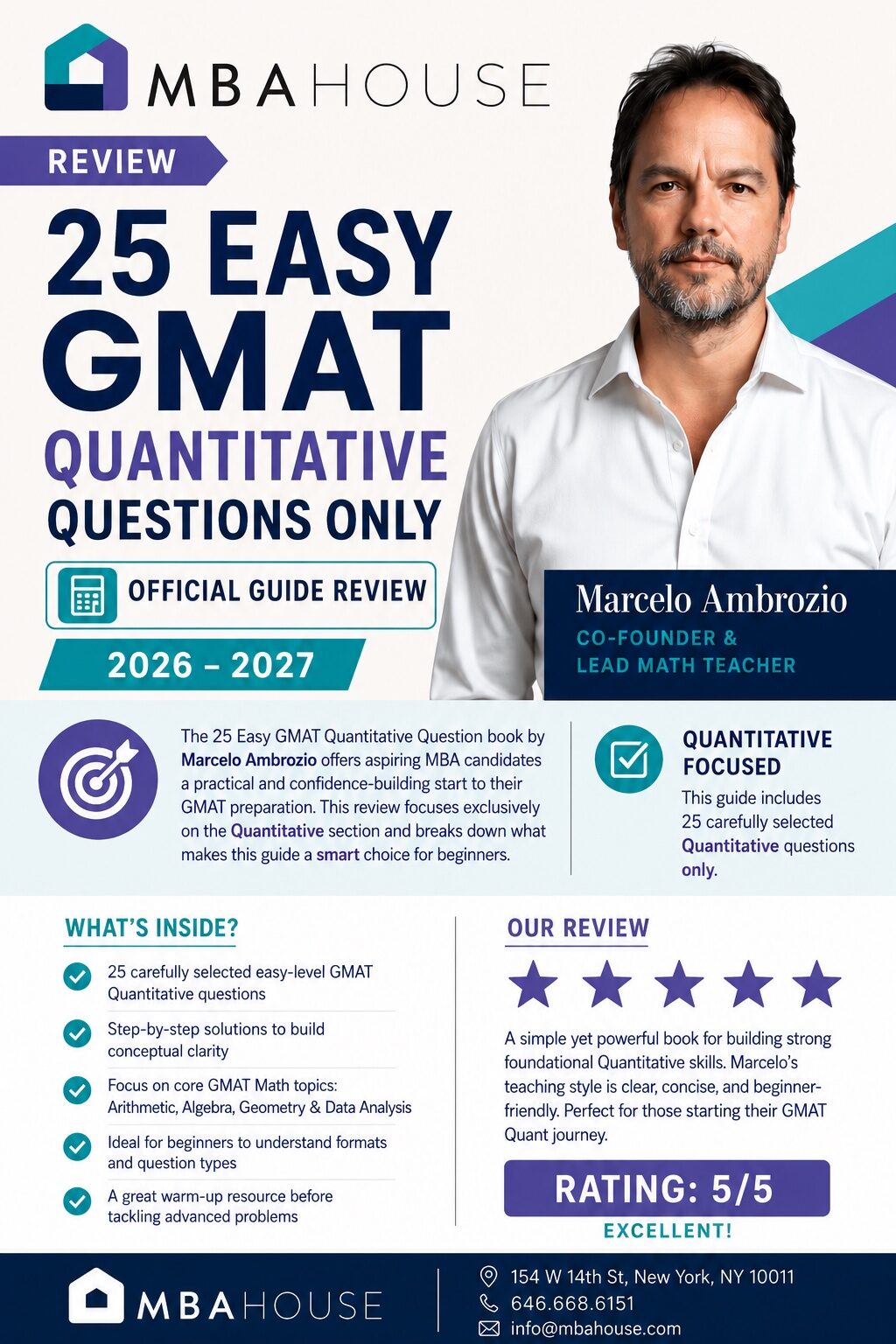
Watch the 25 questions explained
The video below works through 25 easy GMAT Focus Quantitative Reasoning questions from the Official Guide Quantitative Review 2026–2027. Each problem is solved out loud: read the prompt, set it up, do the arithmetic without a calculator, and confirm the answer. These are foundational questions on purpose. Mastering the easy band first is how you free up time and confidence for the medium and hard Problem Solving that decides your Quant score.
The 25 questions explained in the video (PDF)
Download the companion practice set with all 25 questions covered in the video. Print it or open it on a second screen, attempt each problem yourself first, then play the video to compare your setup to the worked solution.
Download the 25-question PDFHow to use the PDF while you watch
Passive watching does not move a Quant score. The point of the PDF is to make this an active study session. Use it like this:
- Attempt first, then watch. Try each question on paper before you see the solution. Give yourself roughly two minutes per question, the same pace the real GMAT Focus expects.
- Write your setup, not just an answer. Jot the equation, the ratio, or the percentage relationship you used. Most missed points come from a rushed setup, not bad arithmetic.
- Pause and compare. When the video reaches a question you got wrong, stop and find the exact step where your path diverged from the clean one.
- Mark, do not erase. Keep your wrong work visible so you can see the pattern in your mistakes later.
What these 25 questions cover
The set is a tour of the foundations of GMAT Focus Quantitative Reasoning. Rather than reproduce every question here, here is the terrain you will practice and why each piece matters on test day:
- Arithmetic and number properties — factors, multiples, odd/even, and the rules that turn a slow computation into a one-line answer.
- Percentages — percent change, percent of a percent, and the difference between "increased by" and "increased to," a classic trap.
- Ratios and proportions — scaling parts to a whole, combining ratios, and converting between ratio and fraction form quickly.
- Basic algebra — solving linear equations, substitution, and translating words into expressions without losing a sign.
- Word problems — rate, work, mixture, and simple profit setups where the hard part is the reading, not the math.
Notice that none of this requires a calculator, and the GMAT Focus Quant section does not give you one. That is the whole reason to drill the easy band: it trains mental arithmetic, estimation, and a disciplined setup so you stay fast and accurate under the clock.
Why "easy" questions deserve your attention
Strong test-takers often skip easy questions and lose points to careless errors. On an adaptive exam like the GMAT Focus, a missed easy question costs you more than a missed hard one, because the algorithm reads it as a sign you have not mastered the fundamentals. Building a near-perfect hit rate on foundational arithmetic, percentages, ratios, and algebra is the cheapest, fastest score gain available. These 25 questions are exactly that practice.
Turn your mistakes into a score with an error log
The single highest-leverage habit in GMAT prep is the error log. After you finish the 25 questions, do not just note which ones you missed. For each miss, record four things:
- The question type (e.g. percent change, ratio, linear equation).
- The exact error (misread the question, wrong formula, arithmetic slip, ran out of time).
- The fix — the one sentence that would have kept you on the right path.
- A re-test date — come back in a week and redo the same question cold.
After a few sessions, your log reveals the two or three patterns that account for most of your lost points. That is where targeted practice pays off, and it is exactly how MBA House tutors turn diagnostic data into a focused study plan.
Want a tutor to review your error log and build the plan around it? MBA House runs live GMAT Focus prep and private tutoring in New York, built on clean problem-solving structure rather than memorized tricks.
Where this fits in your GMAT prep
These easy Official Guide Quantitative Review questions are the foundation layer of GMAT Focus Quant. Once they are automatic, move up in difficulty and tie your practice to a target score. If you are still mapping the exam, start with what the GMAT is and our breakdown of the GMAT Focus Edition. For a harder worked example, try our GMAT profit question with tiered costs. To turn practice into a real score, our GMAT Focus tutor NYC page explains how live classes and private tutoring work, our guide to building GMAT and admissions strategy together shows how a target score should follow your school list, and if you are weighing whether to test at all, read our GMAT, GRE, and EA waiver guide.
Preparing for the GMAT in New York? MBA House offers personalized GMAT Focus tutoring with proven score-improvement strategies and weekly live Quant practice.
GMAT Quantitative Review 2026–2027 FAQs
What is the GMAT Official Guide Quantitative Review 2026–2027?
It is the official supplementary Quant practice book for the GMAT Focus Edition. It contains retired, official-style Quantitative Reasoning problems organized by topic and difficulty, so you practice with the same arithmetic, algebra, and word problems you will see on test day.
How should I use the downloadable PDF with the video?
Open or print the PDF, attempt each of the 25 questions yourself under a soft timer before watching, then play the video to compare your setup and reasoning to the worked solution. Log every miss so you review the pattern, not just the answer.
Are these 25 questions hard?
No. They are deliberately easier, foundational GMAT Focus Quant questions, ideal for building accuracy and speed on arithmetic, percentages, ratios, and basic algebra before you move on to medium and hard Problem Solving.
How long should the 25 questions take?
On the GMAT Focus you have roughly two minutes per Quant question, so a clean target for 25 easy questions is about 35 to 45 minutes. Use the timer to find which question types slow you down, then drill those.
Does the GMAT Focus Quant section allow a calculator?
No. The GMAT Focus Quantitative Reasoning section does not allow a calculator, which is exactly why these easy questions matter: they train the mental arithmetic, estimation, and clean setup you need to stay fast and accurate without one.